isaca
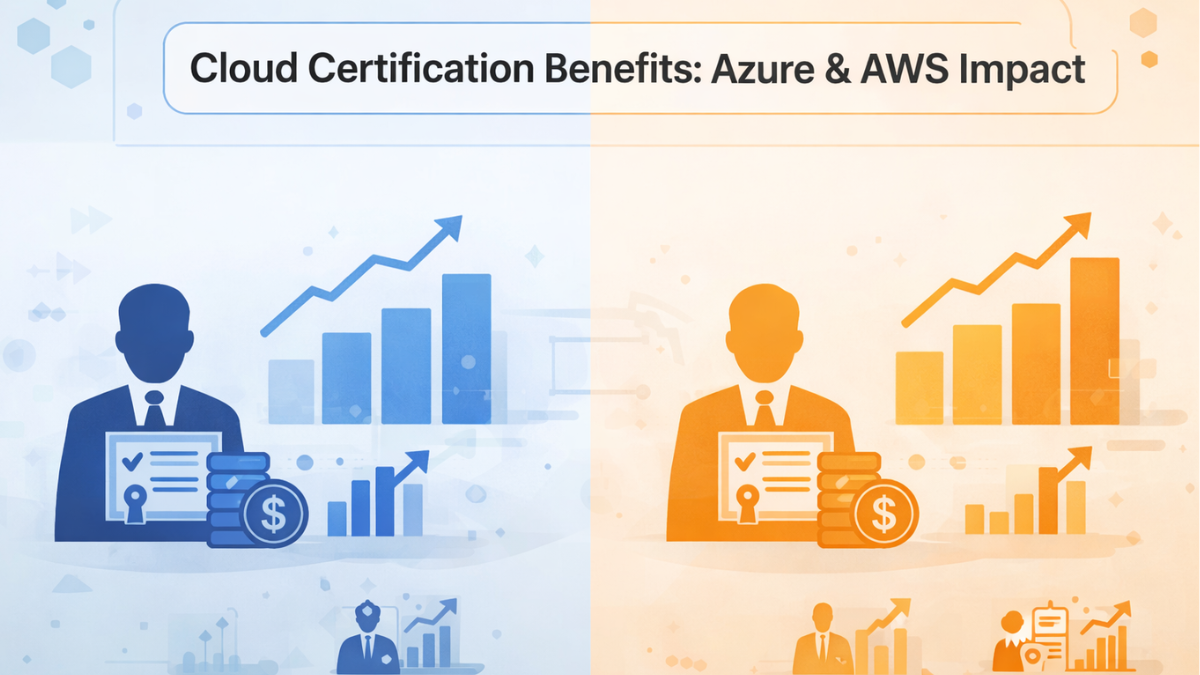

Choosing between Azure and AWS certifications represents a pivotal career decision for IT professionals globally. Both Amazon Web Services (AWS) and Microsoft Azure stand as titans in the cloud computing industry, offering extensive certification programs that validate critical skills in cloud architecture, development, operations, and security. This article provides an objective, data-backed comparison of their certification landscapes, examining career opportunities, salary prospects, difficulty levels, and strategic pathways to help you determine which cloud platform aligns best with your professional aspirations.
Navigating the Cloud Landscape: Azure vs AWS Certification DemandThe global cloud computing market continues its robust expansion, with AWS and Azure holding significant shares, albeit with AWS maintaining a larger lead in overall market size. This translates directly into a high demand for certified professionals in both ecosystems. Organizations are increasingly adopting multi-cloud strategies, further fueling the need for expertise across platforms. Understanding the specific industries and regions where each cloud provider thrives can offer a strategic advantage in your career planning. Azure often sees strong adoption in enterprises already integrated with Microsoft technologies, while AWS holds a broad appeal across startups, government, and diverse corporate sectors.
The job market demand for cloud skills remains exceptionally high. Cloud engineers, architects, and developers who possess certifications from either AWS or Azure are consistently sought after. While AWS has a larger installed base, Azure is rapidly catching up, making certifications from both vendors highly valuable. The choice often comes down to your existing skill set, desired career trajectory, and the specific needs of potential employers. Many professionals find that dual certification can open even more doors, positioning them as versatile cloud experts. According to recent analyses, the demand for cloud professionals shows no signs of slowing, making either certification a wise investment in career growth.
AWS, as the pioneer in the public cloud space, boasts extensive service offerings and a dominant market share, appealing to a wide array of businesses from small startups to large enterprises. Its certifications are highly recognized and often perceived as a benchmark for cloud expertise. Azure, on the other hand, leverages Microsoft's existing enterprise relationships and strong hybrid cloud capabilities, making it a compelling choice for organizations with significant on-premises Microsoft infrastructure. Understanding this nuanced market penetration is crucial for aspiring cloud professionals. For a deeper look into the market dynamics and their impact on career choices, explore this in-depth career analysis.
 Unlocking Career Pathways: Opportunities in Both Ecosystems
Both Azure and AWS certifications open doors to a multitude of high-demand cloud roles, including Cloud Architect, Cloud Engineer, DevOps Engineer, Solutions Architect, Security Specialist, and Data Engineer. While the job titles might be similar, the underlying technologies and specific toolsets differ. An AWS Certified Solutions Architect, for instance, will be proficient in services like EC2, S3, and Lambda, whereas an Azure Solutions Architect will master Azure Virtual Machines, Blob Storage, and Azure Functions. Your choice can influence the types of projects you work on and the industry sectors you engage with.
AWS Certification Career Opportunities: Known for its vast array of services, AWS certifications often lead to roles in companies prioritizing scalability, microservices, and serverless architectures. Opportunities span e-commerce, media, healthcare, and high-tech industries.
Azure Certification Career Opportunities: Favored by enterprises, government agencies, and organizations heavily invested in Microsoft products, Azure certifications frequently lead to roles focusing on hybrid cloud solutions, data analytics with Azure Synapse, and integration with Microsoft 365.
The strategic decision lies in aligning your career ambitions with the dominant use cases and technological philosophies of each platform. Pursuing certifications that match your preferred working environment or target industry can significantly enhance your job prospects and long-term career satisfaction.
Each certification path validates a distinct set of skills essential for specific cloud roles. For example, a certified AWS DevOps Engineer demonstrates proficiency in CI/CD pipelines using AWS CodePipeline and CodeDeploy, while an Azure DevOps Engineer would utilize Azure DevOps Services. Both pathways lead to rewarding careers, but the specific tool knowledge differs. Professionals should consider which vendor’s approach to infrastructure, networking, and application deployment resonates most with their technical background and future goals.
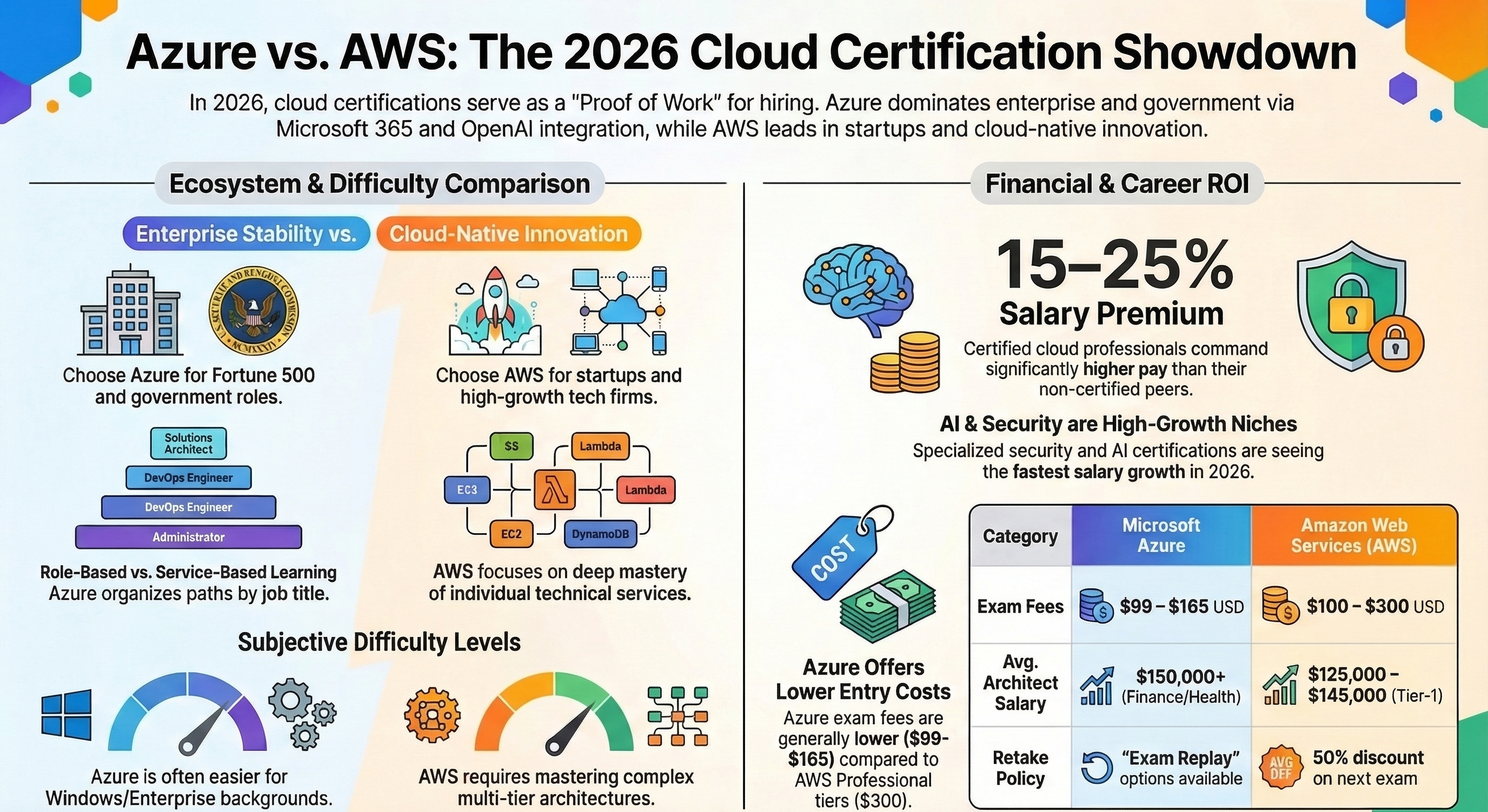
One of the most compelling reasons to pursue cloud certification is the significant boost it can provide to your earning potential. Azure vs AWS certification salary comparisons consistently show that certified cloud professionals command higher salaries than their uncertified counterparts. While exact figures vary based on role, location, experience, and specific certifications held, both AWS and Azure certifications are associated with highly competitive compensation packages.
Generally, AWS certifications, particularly at the associate and professional levels, have historically been reported to lead to slightly higher average salaries dueor to AWS's larger market share and longer tenure in the public cloud space. However, as Azure's market penetration grows and its enterprise adoption solidifies, the salary gap is narrowing. Experienced Azure Solutions Architects and DevOps Engineers are now earning comparable, if not sometimes higher, salaries than their AWS counterparts, especially in regions with strong Azure presence.
Several factors beyond the certification itself impact a cloud professional's salary. Experience plays a crucial role; a professional with five years of hands-on cloud experience and an associate-level certification will likely earn more than a certified beginner. Specialization also matters; certifications in high-demand niches like security (e.g., AWS Certified Security - Specialty, Azure Security Engineer Associate) or machine learning often come with premium salaries. Location is another significant variable, with tech hubs typically offering higher compensation. It’s also worth noting that employers often value practical experience combined with certification as the ideal skill set.
For individuals new to cloud computing, choosing an entry-level AWS certification vs Azure fundamentals course is a crucial first step. Both vendors offer foundational certifications designed to introduce core cloud concepts, services, and billing models without requiring prior hands-on experience. These certifications serve as excellent starting points for a career in the cloud.
The Microsoft Azure Fundamentals (AZ-900) certification provides a broad overview of Azure services, cloud concepts, security, and compliance. It’s ideal for technical and non-technical professionals who need to understand Azure at a high level. Similarly, the AWS Certified Cloud Practitioner (CLF-C01) covers fundamental AWS concepts, services, security, architecture, pricing, and support. This certification is recommended for anyone looking to build a foundational understanding of the AWS Cloud. Both exams test conceptual knowledge rather than hands-on skills, making them accessible to beginners.
The decision between Azure Fundamentals and AWS Cloud Practitioner often hinges on your existing professional environment or academic background. If you're coming from a Microsoft-centric IT environment (e.g., Windows Server, SQL Server, .NET development), Azure might feel like a more natural progression. Conversely, if your background is more open-source or you're aiming for roles in cloud-native startups, AWS might be a better fit. Both certifications provide a solid base from which to launch into more specialized and professional-level certifications.
Beyond the foundational level, both AWS and Azure offer a comprehensive array of associate, professional, and specialty certifications designed for various technical roles. These professional level AWS vs Azure certifications validate deeper technical skills and hands-on experience. The official training resources available from both vendors can greatly assist in preparing for these rigorous exams.
For instance, the AWS Certified Solutions Architect - Associate is a highly sought-after certification that demonstrates proficiency in designing cost-effective, fault-tolerant, and scalable systems on AWS. Its Azure equivalent is the Azure Solutions Architect Expert (AZ-305), which focuses on designing solutions that run on Azure, covering compute, network, storage, and security. Both require a strong understanding of architectural principles and service integration. Similarly, for those focused on development or operations, there are comparable certifications like AWS Certified Developer - Associate and Azure Developer Associate (AZ-204), or AWS Certified SysOps Administrator - Associate and Azure Administrator Associate (AZ-104).
Both cloud providers also offer specialty certifications that dive deep into specific domains such as security, networking, database, data analytics, machine learning, and SAP. These certifications are ideal for experienced professionals looking to validate niche skills and stand out in the job market. For example, an AWS Certified Security - Specialty or an Azure Security Engineer Associate (AZ-500) demonstrates advanced knowledge in securing cloud environments, a critical skill given today's cyber threat landscape. The choice here largely depends on your existing expertise and the specific area of cloud computing you wish to master.
The Azure certification vs AWS difficulty level is a common point of discussion among aspiring cloud professionals. While both platforms offer challenging exams at the professional and specialty levels, many perceive AWS certifications as slightly more demanding due to the sheer breadth of its services and the detailed, scenario-based questions often encountered. Azure exams, particularly at the associate level, sometimes focus more on conceptual understanding and integration with Microsoft's broader ecosystem. However, this is a generalization, and individual aptitude and prior experience heavily influence perceived difficulty.
Effective preparation is key to overcoming the difficulty of any cloud certification. Both Microsoft and AWS provide extensive learning paths, documentation, whitepapers, and practice exams. Hands-on experience with the cloud platform is paramount for success, especially for associate and professional-level exams that test practical application of knowledge. Many candidates also benefit from structured courses, study groups, and practice tests to solidify their understanding. A dedicated and disciplined study approach is far more influential than the inherent difficulty perceived between the two platforms. To enhance your preparation for rigorous cloud exams, consider adopting an effective study methodology that includes practical application and consistent review.
For both Azure and AWS, official documentation serves as the single most authoritative source of truth. Leveraging developer guides, whitepapers, and FAQs directly from Microsoft Learn and AWS documentation is invaluable. Beyond that, many candidates utilize online courses (e.g., Coursera, Udemy, Pluralsight), interactive labs, and community forums. Simulating exam conditions with practice tests helps in identifying knowledge gaps and improving time management. Remember, relying on unauthorized "dumps" is unethical and counterproductive; focus on genuine learning and understanding to build a sustainable career.
The cost of AWS certification vs Azure certification is an important factor for many candidates. Both vendors structure their exam fees similarly, with foundational exams being the least expensive and professional or specialty exams incurring higher costs. Typically, an entry-level exam like AWS Cloud Practitioner or Azure Fundamentals costs around $100. Associate-level exams (e.g., AWS Solutions Architect Associate, Azure Administrator Associate) range from $150 to $165. Professional and specialty exams generally cost $300. These figures are subject to change and may vary by region.
Beyond the exam fees, candidates should also budget for preparation resources. This can include paid online courses, practice test subscriptions, and, crucially, costs associated with hands-on labs in the cloud environment. Both AWS and Azure offer free tiers for new accounts, which allow users to explore many services without charge for a limited period, but more extensive practice may require incurring some usage fees. Factoring in these additional expenses provides a more realistic picture of the total investment required for certification.
While there is a financial outlay involved, the return on investment (ROI) for cloud certifications is generally very strong, given the increased earning potential and career opportunities they unlock. Many organizations also sponsor certification efforts for their employees, recognizing the value these credentials bring to their workforce. Exploring employer benefits, educational discounts, or bundled training packages can help mitigate the overall cost. The long-term career advantages often far outweigh the initial financial investment.
Deciding which cloud certification is better, Azure or AWS, ultimately depends on your individual career goals, existing technical background, and the industry you wish to target. There isn't a universally "better" option, but rather a more suitable one for your specific circumstances.
If you are already working with Microsoft technologies, Azure certifications might offer a smoother learning curve and immediate relevance within your current role or target companies that are Microsoft partners or customers. If your aspirations lie with cloud-native startups, cutting-edge machine learning, or a broader global enterprise market, AWS could be the more direct path. For experienced professionals looking to transition or deepen their cloud expertise, the choice might come down to specific projects or the long-term strategic direction of their organization. The best cloud certification path, AWS vs Azure, is one that aligns with your personal and professional ecosystem.
 Factors Guiding Your Decision
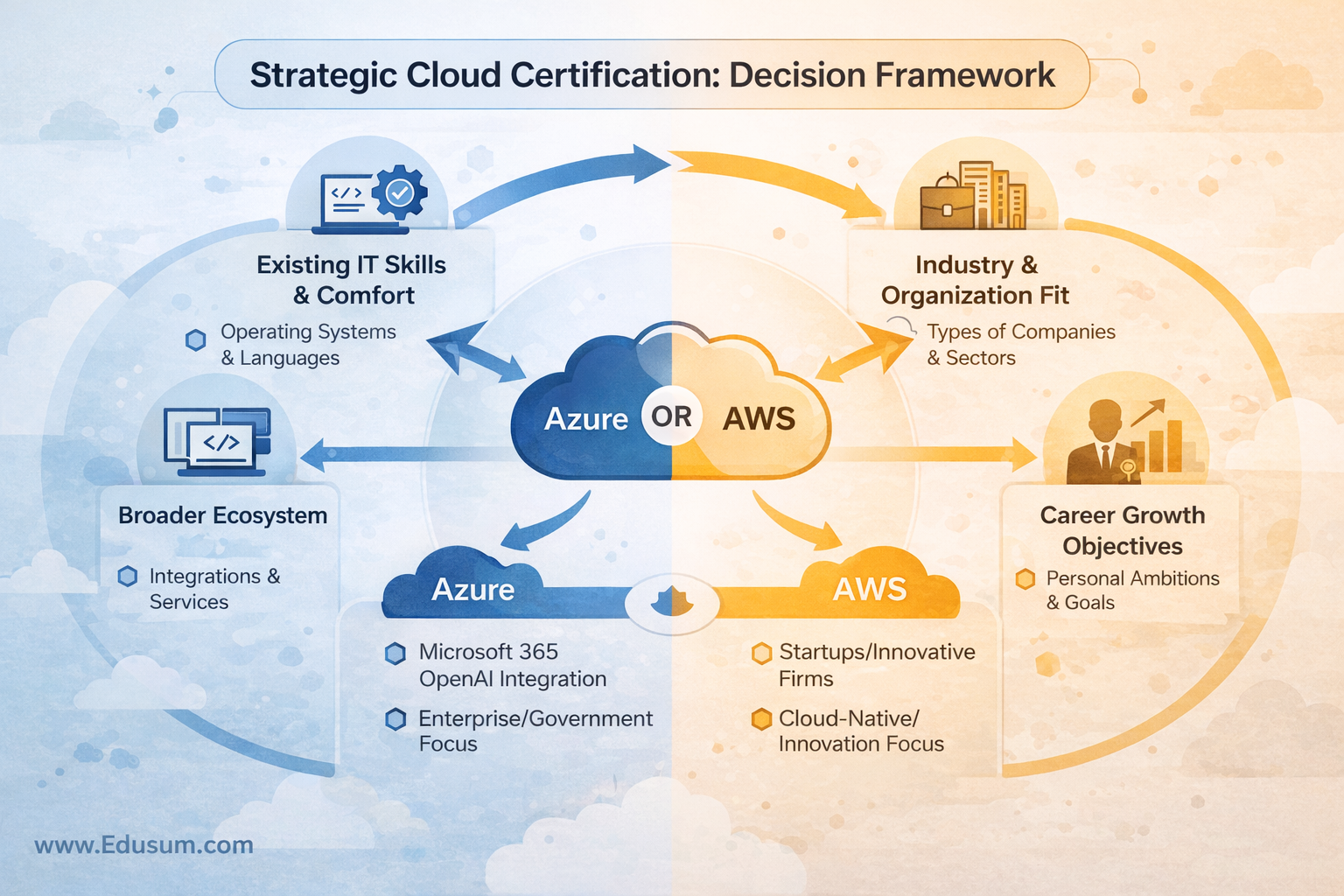
Current Technical Stack: Are you proficient in .NET, SQL Server, and Windows, or more comfortable with Linux, Java, and open-source tools?
Target Industry/Company: Do you envision working for traditional enterprises or fast-paced tech companies?
Geographic Location: Is one cloud provider more dominant in your local job market?
Long-Term Career Goals: What kind of projects do you want to lead, and what technologies excite you most?
Existing Certifications: Do you already hold other vendor-specific credentials that might synergize with one cloud provider more than the other?
Considering these factors will provide clarity in choosing between AWS and Microsoft Azure certifications, ensuring your investment of time and resources is well-placed for your career growth.
The advantages of Azure certification vs AWS are not mutually exclusive; both provide substantial benefits to professionals and organizations alike. For individuals, certification validates expertise, boosts confidence, and often leads to higher salaries and better job opportunities. It demonstrates a commitment to continuous learning and staying current with rapidly evolving cloud technologies. For organizations, certified employees mean reduced operational risk, increased efficiency, and the ability to leverage cloud capabilities more effectively.
Is AWS certification more valuable than Azure? The answer is nuanced. AWS certifications have a slightly longer history and broader recognition, often seen as a baseline for cloud proficiency. Azure certifications, however, are gaining significant traction, particularly in enterprise environments and for hybrid cloud scenarios, providing unique advantages for those focused on the Microsoft ecosystem. Both are highly valuable credentials that signify a professional's ability to design, implement, and manage robust cloud solutions. The true value comes from how you apply that knowledge and continue to grow your skills.
Certification is more than just a badge; it represents a foundational understanding of complex cloud services. The process of studying for and passing an exam forces a structured learning approach that builds practical skills. These skills translate into tangible business benefits, whether it's optimizing costs, enhancing security, or accelerating development cycles. Ultimately, the best certification is the one that best supports your career trajectory and allows you to contribute meaningfully to cloud projects.
The decision between Azure vs AWS certification is a strategic one, deeply intertwined with your career aspirations and the ever-evolving cloud landscape. Both platforms offer robust ecosystems with high demand for certified professionals, significant earning potential, and diverse career pathways. While AWS holds a larger market share and an established reputation, Azure is rapidly growing, particularly within enterprise and hybrid cloud environments, presenting equally compelling opportunities.
Your personal technical background, target industry, and long-term professional goals should guide your choice. Investing in either AWS or Azure certification will undoubtedly enhance your marketability and propel your career forward in the dynamic world of cloud computing. The ultimate success stems not just from the certification itself, but from the depth of knowledge gained and the practical application of those skills in real-world scenarios.
To further deepen your expertise and effectively prepare for specific Azure exams, leveraging comprehensive study resources is essential. Continue building your foundational knowledge and explore advanced topics to ensure you are well-equipped for the challenges and opportunities in cloud technology. For those aiming to master specific Azure exams, such as the AZ-800, focusing on an effective study methodology can make all the difference in achieving certification success and advancing your career in cloud engineering.
1. Which cloud certification is better for beginners, Azure or AWS?
For beginners, both the Microsoft Azure Fundamentals (AZ-900) and AWS Certified Cloud Practitioner (CLF-C01) are excellent starting points. The "better" choice often depends on whether you prefer to learn the Azure ecosystem, which integrates well with existing Microsoft products, or the broader AWS platform, known for its extensive service offerings and widespread adoption.
2. Is AWS certification more valuable than Azure certification?
Neither is inherently "more valuable" in all contexts. AWS certifications historically held a slight edge due to AWS's larger market share and longer tenure. However, Azure certifications are rapidly gaining equivalent value, especially in enterprise settings and for hybrid cloud strategies. Both are highly respected and sought-after credentials that validate critical cloud skills.
3. How do Azure vs AWS certification salaries compare?
Salaries for certified professionals in both Azure and AWS are highly competitive and generally above average. While some reports suggest AWS certifications might lead to marginally higher salaries on average, the gap is narrowing. Factors like experience, specialization (e.g., security, data), location, and specific role have a greater impact on earning potential than the cloud provider itself.
4. What are the key differences in career opportunities between AWS and Azure certifications?
AWS certifications often lead to roles in companies prioritizing scalability, microservices, and a broad range of cloud-native solutions, prevalent in e-commerce, startups, and media. Azure certifications frequently open doors in enterprises, government, and organizations leveraging Microsoft's existing ecosystem for hybrid cloud and integrated services like Microsoft 365.
5. What is the typical difficulty level of professional-level Azure vs AWS certifications?
Both professional-level Azure and AWS certifications are challenging and require significant hands-on experience. Many professionals find AWS exams to be slightly more complex due to the breadth of services and scenario-based questions. Azure exams, particularly at the associate level, sometimes focus more on conceptual understanding and Microsoft integration. However, perceived difficulty is subjective and largely depends on individual background and preparation.