


The best cybersecurity certification is the one that matches your job role, not the one with the loudest brand. A SOC analyst should start with CompTIA Security+, a tester with CEH, an auditor with CISA, a manager with CISM and a senior architect with CISSP. This guide shows why, with exam facts for each.
Which cybersecurity certification fits which job role?
Each of the five main credentials was built for a different kind of work, so the right pick depends on what you do all day. Security+ proves core skills for operations, CEH proves offensive testing, CISA proves audit skills, CISM proves program management and CISSP proves broad senior judgment.
Here is the quick map. The numbers come from the vendor pages and the EduSum exam sheets, checked on 31 October 2026.
| Job role | Best fit | Questions | Duration | Passing score | Exam fee |
|---|---|---|---|---|---|
| SOC analyst | CompTIA Security+ SY0-701 | Up to 90 | 90 minutes | 750 on a 100 to 900 scale | $439 |
| Ethical hacker | EC-Council CEH v13 | 125 | 240 minutes | 60 to 85 percent range | $950 |
| IT auditor | ISACA CISA | 150 | 240 minutes | 450 out of 800 | $575 member, $760 nonmember |
| Security manager | ISACA CISM | 150 | 240 minutes | 450 out of 800 | $575 member, $760 nonmember |
| Architect or senior practitioner | ISC2 CISSP | 100 to 150 | 180 minutes | 700 out of 1000 | $749 |
Fees are US list prices and change often, so confirm the current price on the vendor page before you book. If you want the same exams arranged as a climb from entry level to expert instead of by job, read the companion piece on how the 4-step certification ladder works.
Why does the job role matter more than the brand?
Employers hire for tasks, and a certification is only useful when it matches the tasks in the posting. Passing an exam that is wrong for your role costs the same fee and weeks of study, yet it will not move your resume to the top of the pile.
Think about three people with the same budget. One studies for CISSP before she has ever worked in a security team. She meets the content, but not the five years of experience that ISC2 lists as a requirement for the full credential (ISC2, 2026). Another buys CEH when his job is vendor risk reviews, so none of the tools he practiced appear in his day. The third picks Security+ on day one, lands a first analyst role and builds from there.
Only the third person spent money on a credential that matched the next job. Nothing about the other exams is bad. They were simply early or sideways for those people.
Use this three-question filter before you pay for anything:
- What will I do in my next role? Operate tools, test systems, review controls, lead a team or design systems.
- What do job postings in my region ask for by name? Read ten postings and count the certification names.
- How much experience do I have today? Some exams list experience requirements and some do not.
What does the job market say about certifications?
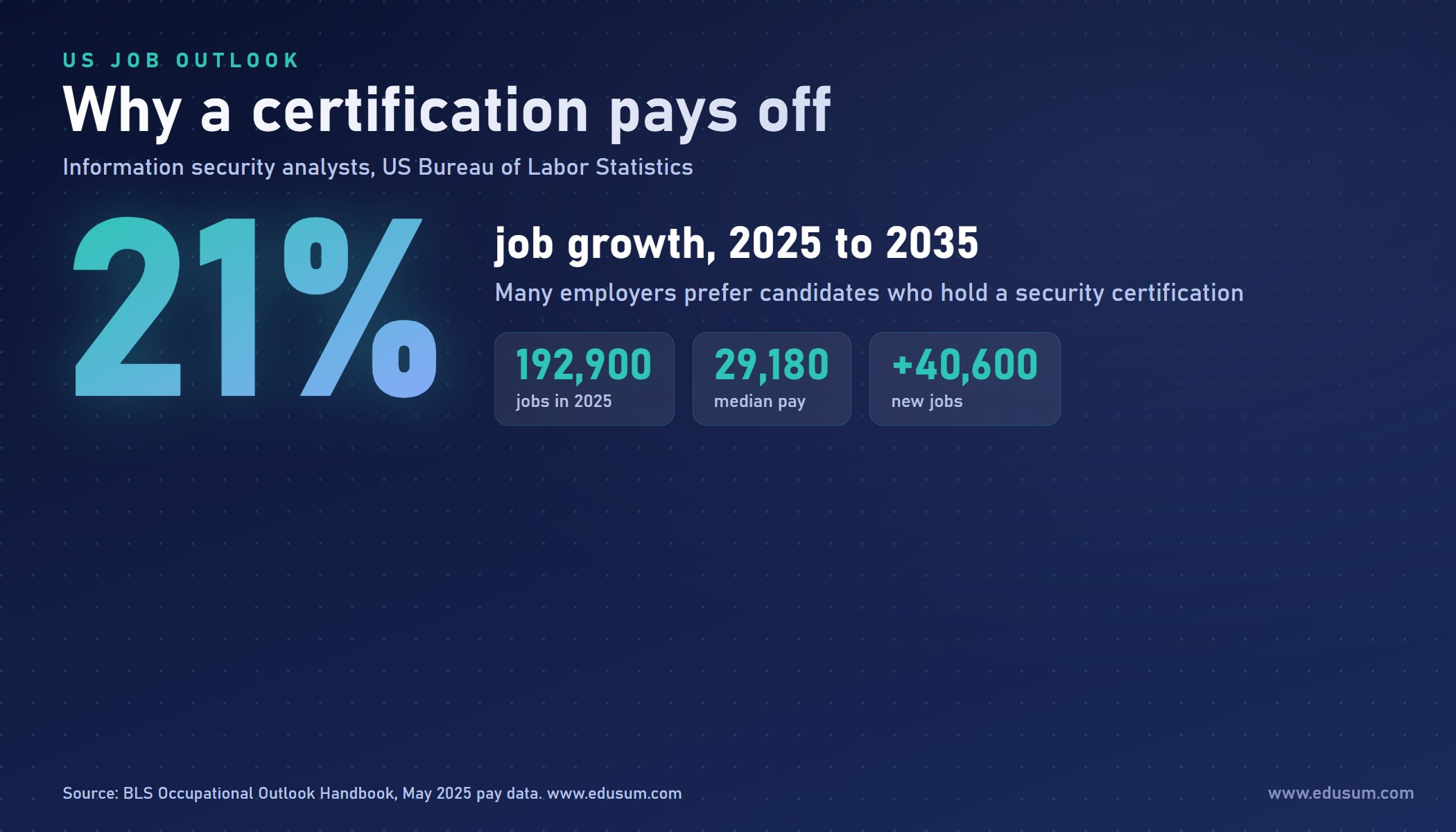
Demand is strong, and employers say they prefer certified candidates. The US Bureau of Labor Statistics reports a median pay of $129,180 per year for information security analysts in May 2025, with 21 percent job growth projected from 2025 to 2035, and about 192,900 jobs in 2025 (BLS Occupational Outlook Handbook).
The same handbook notes that many employers prefer candidates who hold an information security certification, and that certifications exist for entry level workers, experienced workers and specialist areas such as systems auditing. It also lists a bachelor's degree as the typical entry route, with some people entering through a high school diploma plus training and certifications.
Two honest limits apply. First, the BLS figures describe one occupation, so they do not tell you what a specific certification adds to your pay. Second, a certification does not replace skills. It makes your skills easier for a hiring manager to trust. For a detailed look at how one certification can change a study plan and a career case, see the ISC2 CC study plan on this blog.
Read the source yourself on the BLS handbook page before you quote the numbers elsewhere.
Is Security+ the right start for a SOC analyst?
Yes, Security+ is the strongest starting point for an operations role such as SOC analyst. CompTIA describes SY0-701 as an exam of up to 90 questions in 90 minutes with a passing score of 750 on a scale of 100 to 900, and the content leans heavily toward day to day security operations.
Meet Maya, a composite example of a helpdesk technician who wants to move into a security operations center. Her daily future work is alert triage, log review, incident response steps and tuning controls. That lines up with the largest domain on the exam.
The five SY0-701 domains and weights, according to CompTIA:
- Security operations: 28 percent.
- Threats, vulnerabilities and mitigations: 22 percent.
- Security program management and oversight: 20 percent.
- Security architecture: 18 percent.
- General security concepts: 12 percent.
Notice that operations plus threats make up half of the exam. If your study time is short, spend it where the points are. CompTIA recommends Network+ and two years in a security or systems administrator role before the exam, though the recommendation is not a requirement. The full objective list is on the CompTIA Security+ page.
A short video walk-through helps before you open the objectives:
Ninety questions in ninety minutes is about one minute per question, and performance-based questions take longer. Practice the pace early. If you want to see the domain breakdown with sub-topics, the Security+ syllabus overview lists them.
How should Maya study for SY0-701 in eight weeks?
Maya has a full time job, so she plans eight weeks with four sessions a week. The order follows the weights, not the order of the book.
- Weeks 1 and 2: security operations. Learn alert triage, logging, vulnerability management and incident response steps. This is 28 percent of the exam and it is also her future job.
- Weeks 3 and 4: threats, vulnerabilities and mitigations. Build a one page sheet of attack types and the control that stops each one.
- Weeks 5 and 6: program management, then architecture. These two together carry 38 percent.
- Week 7: general security concepts, which is the smallest domain at 12 percent but sets the vocabulary for everything else.
- Week 8: two full timed practice sets, then a review of every missed question by domain.
The review step matters most. A missed question tells you which domain to revisit, and a pattern of misses tells you where your plan is wrong.
Should a hands-on tester choose CEH?
Choose CEH if your goal is to think and work like an attacker so that you can find weaknesses before real attackers do. EC-Council's Certified Ethical Hacker v13 lists 125 questions, 240 minutes and a $950 fee on the EduSum exam sheet.
Meet Dev, a composite example of a network engineer who enjoys breaking his own lab. He wants to move into penetration testing. CEH gives him a structured view of reconnaissance, scanning, system attacks, web application attacks and reporting, which are the stages a tester writes up for a client.
Why does CEH suit him? There are three reasons:
- It names the toolset. Testers are asked about techniques and tools, so the certification vocabulary matches job interviews.
- It is long on purpose. Four hours is the longest sitting in this guide, so stamina matters as much as recall.
- It pairs with other skills. A tester without scripting and lab practice will struggle, so treat CEH as one part of a portfolio.
The pass mark on the EduSum sheet shows as a 60 to 85 percent range, which signals that the cut score can differ between exam forms. Read the current candidate handbook before booking, and check the details on the EC-Council CEH page.
Why do auditors choose CISA?
Auditors choose CISA because it is built around reviewing systems and controls against a standard, which is the exact job of an IT auditor. ISACA lists 150 questions, 240 minutes and a passing score of 450 out of 800, and the EduSum sheet shows fees of $575 for members and $760 for nonmembers.
Meet Rosa, a composite example of a finance team analyst who reviews access to accounting systems. She does not run attacks and she does not manage the security team. She asks whether the controls exist, whether they work and whether there is evidence. CISA organizes its content around that kind of assurance work.
How does an auditor think differently from a tester? An auditor starts from a standard and asks for proof. A tester starts from a system and tries to break it. Both find weaknesses, but they write different reports for different readers.
If your role is close to risk and compliance, CISA also helps you speak the language of internal audit and regulators. Check the official ISACA CISA page for the current experience requirements before you plan the exam date, because they can change.
When does a security manager need CISM?
A security manager needs CISM when the job moves from doing security work to running a security program. ISACA's CISM exam lists 150 questions in 240 minutes, with a passing score of 450 out of 800, and the same member and nonmember fees as CISA on the EduSum sheet.
Meet Tom, a composite example of a team lead with six analysts. His days are about budgets, risk decisions, incident communication and explaining security to executives. A technical exam would not prove those skills.
CISM groups its content into four areas, which tells you what the credential values:
- Information security governance.
- Information risk management.
- Information security program.
- Incident management.
The program and incident areas carry most of the weight on the exam, according to the EduSum syllabus page. That matches the manager's real world: build the program, then run the response when something goes wrong. Read the CISM exam syllabus to see the percentage for each area.

Tom's real test is not memory. It is whether he can pick the best answer when two options are both reasonable, and that is how many management exam questions are written. He should ask of every scenario: who owns the risk, what does the business need and what is the next step in the process?
One practical tip: managers often have little study time. Block two short sessions a week and one longer session on the weekend, and use scenario questions, because CISM rewards judgment more than memorized terms.
Is CISSP the right choice for architects and senior practitioners?
CISSP is the right choice for people who design, advise on or oversee security across many areas, because it covers eight domains in a single exam. ISC2 lists those domains as Security and Risk Management, Asset Security, Security Architecture and Engineering, Communication and Network Security, Identity and Access Management, Security Assessment and Testing, Security Operations and Software Development Security (ISC2, 2026).
Meet Chen, a composite example of a senior engineer with seven years of experience who now advises product teams on design choices. He is not tied to one tool. He needs to reason about identity, networks, software and risk together. That breadth is what CISSP rewards, and ISC2 lists five years of required work experience on the certification page.
The EduSum sheet shows CISSP at $749, with 100 to 150 questions, a 180 minute limit and a passing score of 700 out of 1000.
ISC2 also notes that a new exam outline takes effect on 15 April 2027. If you plan to sit for CISSP in the coming months, check which outline applies to your exam date and study from that outline only. Mixing two versions is a common way to waste study time. You can see the full objective list on the ISC2 CISSP page.
How do the five exams compare on time and money?
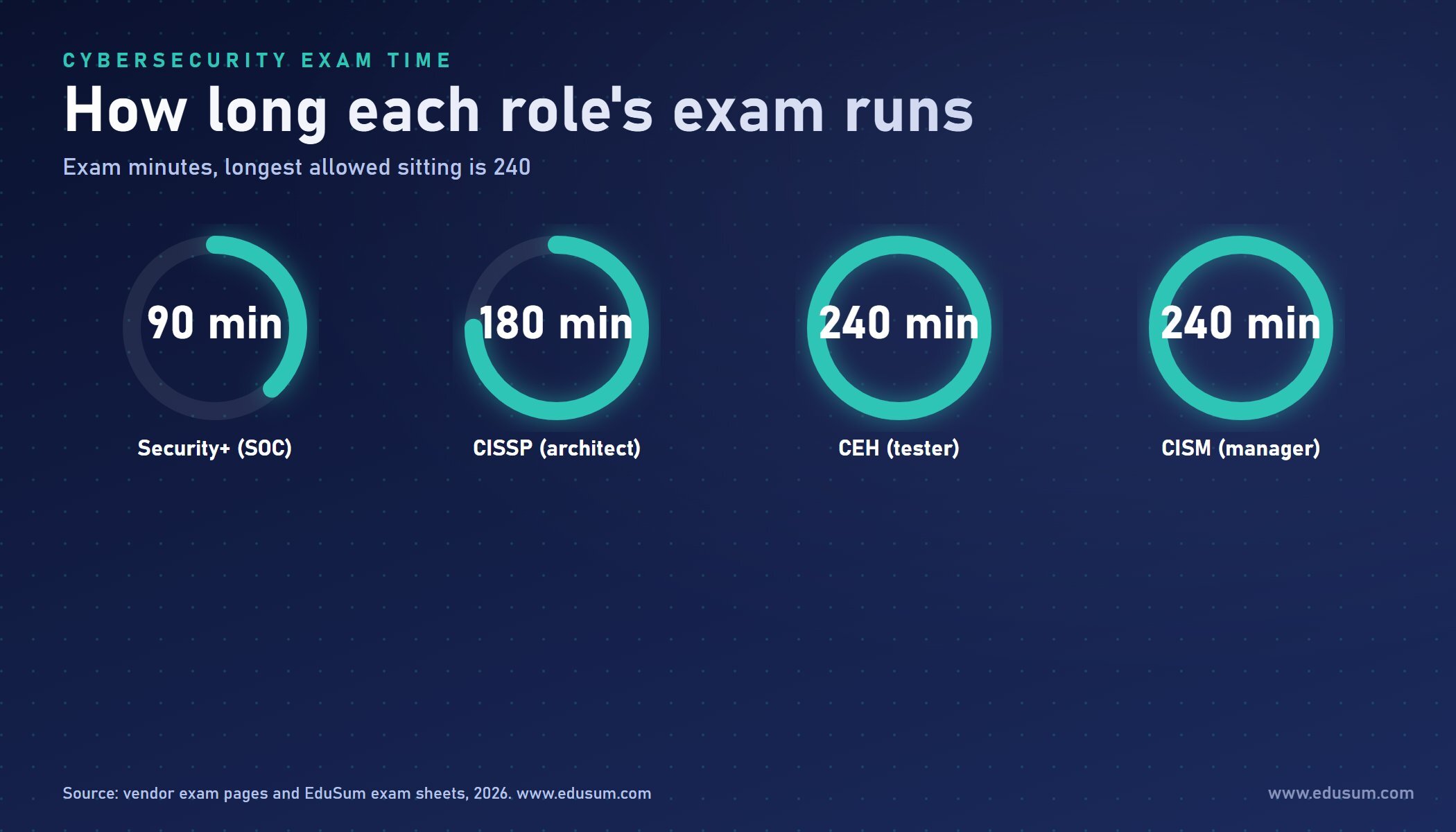
The exams differ most in length and fees, and those differences should shape your plan. Security+ is the shortest at 90 minutes and the lowest fee on this list at $439, while CEH, CISA and CISM each run 240 minutes, and CISSP sits between them at 180 minutes.
Here is what the comparison means in practice:
- Short exam, fast pace. Security+ gives you about one minute per question, so speed and pattern recognition matter.
- Long exam, stamina. A four hour sitting needs a plan for focus. Practice with full length timed sets at least twice.
- Higher fee, higher stakes. At $950, a CEH retake is expensive, so book only when your practice scores are steady.
- Experience gates. CISSP lists five years of required experience, while Security+ lists a recommendation only.
Add the cost of study material and any membership fee, then divide by the number of months you can realistically study. That number tells you whether to choose the exam now or build experience first.
How do you choose when two roles fit you?
When two roles fit, choose the credential for the job you want in twelve months, not the job you have today. Then confirm it by checking that at least five postings in your target market name the certification.
Use this short decision guide:
- Operations plus testing curiosity: take Security+ now and plan CEH after a year of real alerts.
- Audit plus management goals: take CISA first if audits are your daily work, and CISM when you start leading people.
- Technical depth plus advisory work: build five years of experience, then take CISSP.
- No experience at all: start with Security+ and a home lab, then revisit this list.
Three mistakes are worth avoiding. The first is chasing the most famous exam instead of the most relevant one. The second is studying from an outdated exam outline. The third is skipping timed practice, which leaves the clock as a surprise on exam day. Practice questions help you find weak domains early, as long as you use them to learn and not to memorize answers. Each vendor publishes the outline you should follow, and the EduSum syllabus pages summarize the domains for the exams covered here.
None of this guarantees a pass or a new job. It gives you a clearer plan, and a clearer plan is the best use of a limited budget.
What should you ask an employer before you pick?
A short conversation can save months. If you already work in IT, ask your manager or a recruiter three things:
- Which certification do you list most often for this role? The honest answer is better than any ranking.
- Does the company pay for exam fees or training? Many employers cover fees, and some tie the support to staying on the team for a period.
- Does the role need a certification for contracts or compliance? Some government and defense work lists approved credentials by name, so check the requirement for your target employer.
Write the answers next to the five roles above. If two answers point to the same exam, you have your pick.
What could a twelve month plan look like for each role?
A plan turns a vague goal into a calendar. These are examples built from the facts above, not promises, so adjust them to your own life.
- Maya, SOC analyst: months 1 to 3 for Security+ study and exam, months 4 to 12 for real alert work and a home lab with a free log tool, then decide between CEH and a leadership path.
- Dev, tester: months 1 and 2 on lab practice, months 3 to 5 on CEH study, month 6 for the exam, then months 7 to 12 on a public portfolio of write-ups from legal practice labs.
- Rosa, auditor: months 1 to 4 on CISA study alongside current audits, because her daily work doubles as practice, then evidence of the credential on her resume at the next review.
- Tom, manager: months 1 to 2 reviewing the CISM outline and finding gaps, months 3 to 5 on study with scenario questions, then an exam date that avoids budget season.
- Chen, architect: months 1 to 3 mapping his experience to the eight CISSP domains and noting the weak ones, months 4 to 8 on study, and a check of which outline applies before booking.
Notice that none of these plans starts with the exam fee. They start with the role, then the gap, then the date. That order keeps you from paying for an exam too early.
Frequently asked questions about the best cybersecurity certifications
What is the best cybersecurity certification for beginners?
CompTIA Security+ is the most common beginner choice. SY0-701 lists up to 90 questions in 90 minutes and a passing score of 750 on a 100 to 900 scale, according to CompTIA. Confirm the current price and prerequisites on the vendor page.
Which cybersecurity certification pays the most?
No source in this guide ties one certification to a fixed salary. The BLS reports a $129,180 median pay for information security analysts in May 2025, but pay depends on role, location and experience. Choose the certification that fits your target job.
Do I need experience before CISSP?
ISC2 lists five years of required work experience for CISSP on its certification page (2026). If you are short of that, confirm the current rules with ISC2 before you plan an exam date, and build experience while you study.
Is CEH or Security+ better for a security career?
They serve different jobs. Security+ fits operations roles such as SOC analyst, while CEH fits offensive testing roles. If you are new, many people start with Security+ and add CEH when they have lab practice and clear testing goals.
How long should I study for a security certification?
It depends on your background and the exam. A plan of eight to twelve weeks of steady study is common for a first professional exam. Use the published domain weights to decide how much time each area gets, and take timed practice sets.
Whichever role you are aiming for, choose one exam, put a date on the calendar and build a weekly plan around the vendor's current outline. Start with the credential that matches your next job, and add the others as your career grows.