


Planning CCT 212-82 study time starts with one number: 22. That is how many modules EC-Council's Certified Cybersecurity Technician course covers, and the exam draws from all of them. Group those 22 modules into six weekly blocks and a six-week plan becomes a schedule you can actually keep, not a vague "study more" resolution.
What Is the CCT 212-82 Exam at a Glance?
CCT 212-82 is EC-Council's entry-level cybersecurity certification, built for people with little or no hands-on security experience rather than working analysts. The exam holds 60 questions, split between 50 multiple-choice items and 10 hands-on practical tasks, according to EC-Council's CCT page. EC-Council gives the passing score as a range of 60% to 85%, and its page does not explain how the figure for your sitting is set.
The EduSum exam sheet lists the exam fee as $499, while EC-Council's $999 course offering includes a proctored exam voucher valid for one year. The duration is shown as 3 hours in the exam details and 185 minutes in the FAQ, and the EduSum sheet lists 180 minutes. Here is the full picture in one table.
| Field | Detail |
|---|---|
| Exam code | 212-82 |
| Questions | 60 (50 multiple-choice, 10 performance-based) |
| Duration | About 3 hours (185 minutes in the EC-Council FAQ, 180 on the EduSum exam sheet) |
| Passing score | 60% to 85% |
| Price | $499 exam fee (EduSum exam sheet); $999 course with exam voucher (EC-Council) |
| Modules | 22 |
Those numbers only matter once you turn them into a schedule. People who treat CCT as a side project without a weekly target are the ones who end up cramming the last ten modules into a single weekend, and that is also roughly when the exam's cost stops feeling worth it. A separate CCT 212-82 market value breakdown looks at what the credential is worth once you have it; this guide is about the six weeks before that question matters.
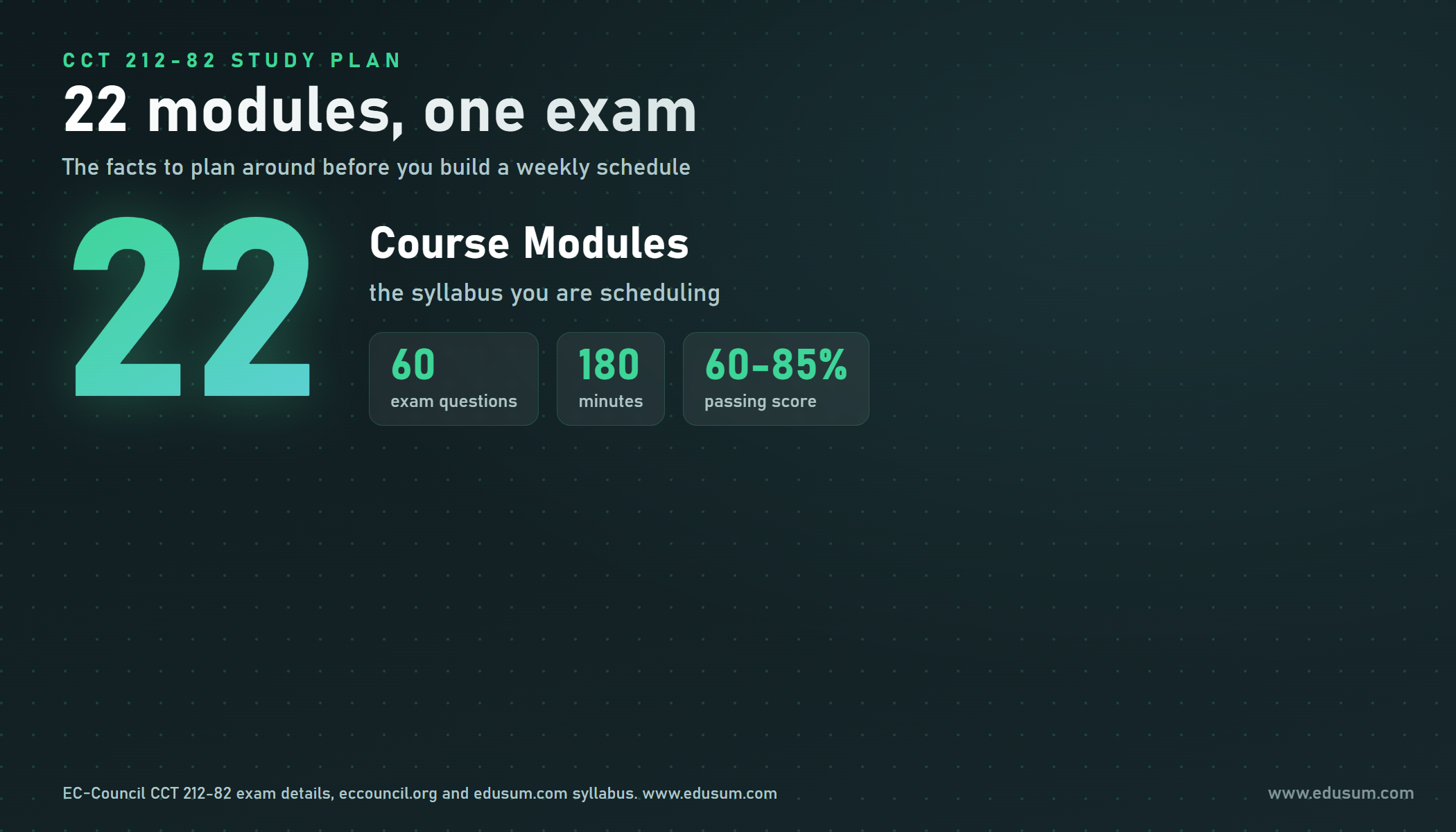
You can confirm every figure above on EC-Council's official CCT page, which also lists the course prerequisites (none) and the certification's position as EC-Council's foundational technical credential.
That "no prerequisites" detail matters for how you plan, because it means the course assumes nothing about your background beyond basic computer use. Someone coming from a help desk role and someone coming from outside IT entirely are both starting the same 22 modules at the same point, even though their study pace through individual blocks will differ. EC-Council's page describes remote proctoring in one place and an exam centre in another, so check how your sitting is delivered and book a date a week or two ahead, so that a date search does not become the reason your six weeks slip to seven.
How Are the 22 CCT Modules Grouped Into Study Blocks?
EC-Council does not publish a percentage weighting per domain for CCT 212-82, unlike some of its other exams, so there is no official "this module is worth 15 percent of your score" figure to study around. What the vendor does publish is the module list itself, and those 22 modules fall naturally into six thematic blocks by subject matter.
Block one covers foundations: information security threats and vulnerabilities, then the attack types built on top of them. Block two is the heaviest, holding six modules on network security itself, from fundamentals through identification and authorization, administrative controls, physical controls, technical controls, and the assessment techniques used to test all of it. Block three moves into application, cloud, and connected-device security across five modules: application security, virtualization and cloud computing, wireless networks, mobile devices, and IoT or OT environments.
Block four is a short, dense pair: cryptography and data security. Block five covers network operations with three modules on troubleshooting, traffic monitoring, and log analysis. Block six closes the course with incident response, computer forensics, business continuity and disaster recovery, and risk management, four modules that share a common theme of what happens after something goes wrong.
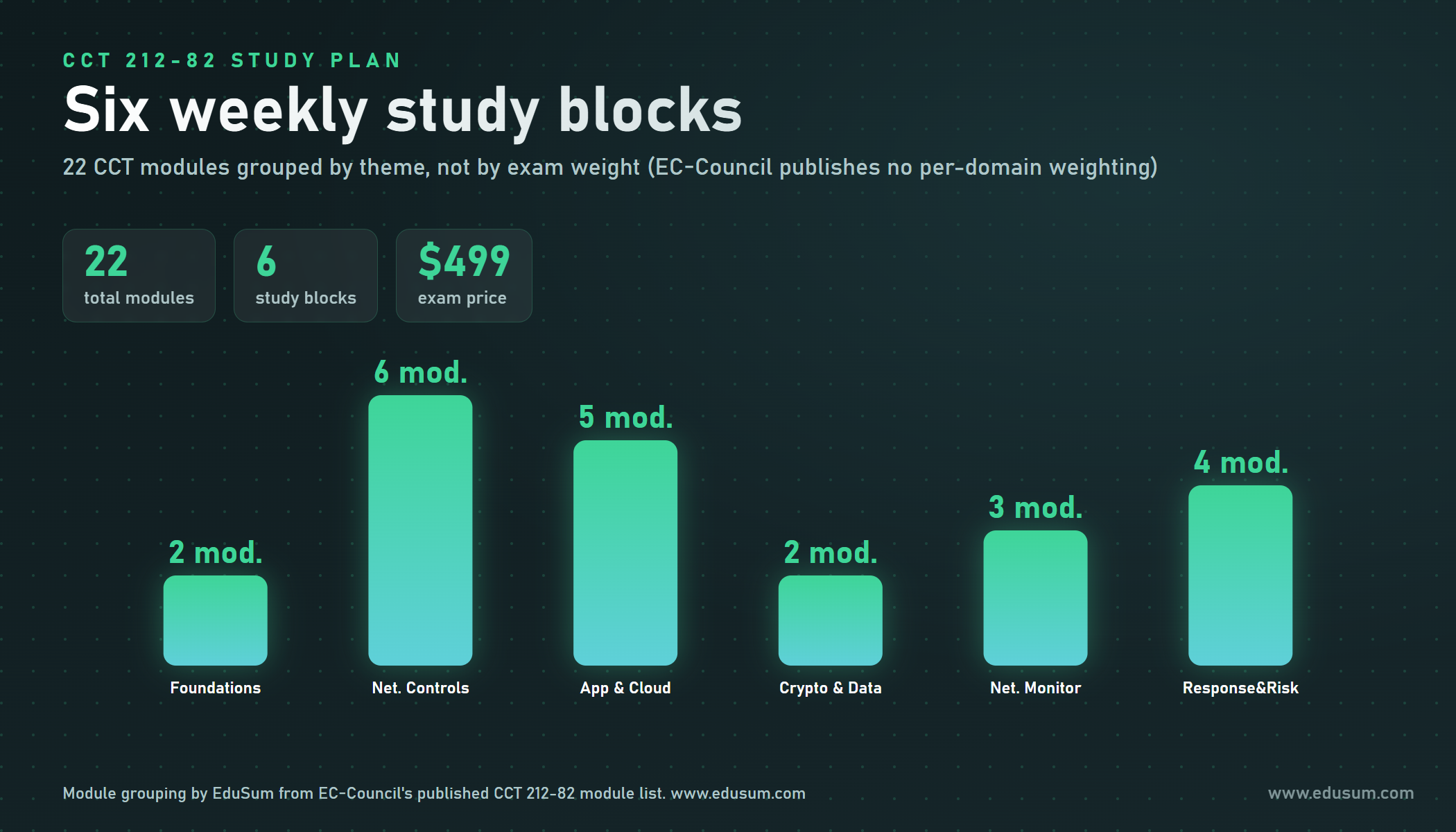
This grouping comes from the full CCT 212-82 exam syllabus rather than from EC-Council's own weighting, because none exists publicly. Grouping by theme instead of by score weight still gives you something more useful day to day: a reason to study several related modules back to back instead of hopping between unrelated topics in the same week.
It also means you cannot plan CCT the way you might plan an exam with published domain weights, where a candidate short on time can skip the lightest domains and focus only on the heaviest ones. EC-Council's public pages show no weighting for any module, so it is safest to treat all 22 as examinable, and a plan that skips block four because it is only two modules risks missing questions just as easily as skipping block two because it feels dense. The six-block structure in this guide is about pacing your time, not about deciding what to leave out.
How Long Should Your CCT Study Plan Run?
Six weeks fits most first-time candidates studying part time, roughly five to seven hours a week alongside a job or classes. That maps one week to each of the six blocks above, with block two's six modules stretched slightly longer than the others since it is nearly three times the size of block one or four.
If you already work in IT support or a help desk role, you likely know large parts of block two and block five from daily troubleshooting, and could compress the plan to four or five weeks. If security is genuinely new to you, stretching blocks two and three to a week and a half each, and pulling the exam date out to seven or eight weeks total, is a more realistic target than forcing six weeks regardless of your starting point.
What does not change with pace is the order. Studying cryptography before you understand basic network controls makes both topics harder to retain, because cryptography's use cases only make sense once you know what it is protecting.
Weekday versus weekend study also changes how a six-week plan actually feels. Five hours spread across five weekday evenings leaves each session under an hour, enough for one sub-topic and a short quiz. Compressing the same five hours into a single weekend session covers more ground per sitting but leaves six days between touches on the material, which is longer than most people retain new technical vocabulary without review. A middle path, three shorter weekday sessions plus one longer weekend session per week, tends to hold up better over six weeks than either extreme.
What Should Weeks 1 and 2 Cover?
Week one is block one: information security threats, vulnerabilities, and attacks. This is vocabulary-building work. You are learning to name and categorize what you will spend the rest of the course defending against, so focus on recognizing attack types and threat categories rather than memorizing every term on first pass.
Week two opens block two, the six-module network security block, and this is where most candidates should budget extra time. Start with network security fundamentals and identification, authentication, and authorization, since every later module in this block assumes you already have that baseline. Administrative, physical, and technical controls build on each other in that order, and the network security assessment module ties the whole block together by showing how those controls get tested in practice.
Because block two is the largest single block, consider splitting it across the boundary into week three rather than compressing all six modules into seven days. A study plan that bends slightly around its heaviest block holds up better than one that assumes every week is equally light.
A workable day-by-day rhythm for week one looks like this: two sessions reading through threats and vulnerabilities, one session building a simple list of attack types with your own one-line description of each, then one review session where you try to name every term from memory before checking your notes. That last step, testing recall before reviewing rather than just re-reading, is what moves the vocabulary from "I recognize this" to "I can explain this," which is closer to what the exam actually asks of you.
What Should Weeks 3 Through 5 Cover?
With block two's overflow absorbed, week three (or the back half of week two) finishes network security controls and assessment, then moves into block three: application security, virtualization and cloud computing, wireless network security, mobile device security, and IoT or OT security. These five modules share a pattern worth noticing as you go. Each one asks the same underlying question, what does this environment expose that a traditional wired network does not, just applied to a different technology.

A wireless router that ships with a default administrator password, or a mobile device that mixes work and personal data on one unlocked screen, are the kind of everyday examples worth keeping in mind while you work through these five modules. The underlying principle in block three is less about memorizing a specific protocol and more about recognizing that convenience features on connected devices routinely create the security gaps that the rest of the module covers how to close.
Week four or five is block four: cryptography and data security. These two modules are short in module count but dense in content, covering encryption types, key management basics, and how data security principles apply to information at rest and in transit. Give this block its own uninterrupted study session rather than squeezing it between other topics, since cryptography concepts tend to need a second pass before they stick.
A useful way to check whether cryptography concepts have actually landed is to explain, out loud or in writing, why encrypting data at rest and encrypting data in transit solve two different problems rather than one. If that distinction is still fuzzy at the end of the block, it is worth another evening before moving on, since data security builds directly on top of it in the second half of the same block.
By the middle of this stretch you are roughly halfway through the module list and past the densest technical block. If your pace has slipped by a few days, this is a reasonable point to compare your remaining weeks against a 60-day ISC2 CC study plan for a sense of how a comparably paced, module-by-module schedule holds together over a longer runway.
What Should Weeks 6 and 7 Cover?
Week six is block five: network troubleshooting, network traffic monitoring, and network logs monitoring and analysis. These three modules read almost like a single extended topic, since troubleshooting a network and monitoring it for anomalies rely on the same diagnostic instincts applied to different goals. Study them together rather than spacing them across separate weeks.
Week seven is block six, the incident response cluster: incident response itself, computer forensics, business continuity and disaster recovery, and risk management. This block answers "what happens after," which makes it a natural point to look back across the whole course. Incident response and forensics are closely linked in practice, since a response plan frequently depends on forensic evidence to confirm what actually happened. Business continuity and risk management then zoom out from a single incident to the organization's broader exposure.
If you are following the compressed six-week version of this plan, blocks five and six can combine into a single final study week, since together they are only seven modules and share a practical, operations-focused tone.
Business continuity and disaster recovery is worth slowing down on even though it is only one module, because candidates coming from a purely technical background sometimes treat it as a formality. It is really asking a different kind of question than the modules before it: not "how do you detect or respond to an incident" but "how does the organization keep functioning while that response is underway." Risk management closes the course by asking you to weigh likelihood against impact across everything the previous 21 modules covered, which is a reasonable note to end on since it ties the whole syllabus back together.
How Should You Spend the Final Week Before the Exam?
The last week is for practice, not new material. Work through timed practice questions that mirror the 50 multiple-choice and 10 performance-based split, since the hands-on tasks reward comfort with a lab interface as much as they reward knowing the underlying concept. A set of CCT 212-82 practice questions built to that same format is a reasonable way to rehearse both halves of the exam under a clock.
Spend one session reviewing block two and block three, the ten modules that make up nearly half the course, since they carry the most ground to forget if you studied them weeks earlier. Spend a second session on anything that gave you trouble in earlier weeks rather than re-reading material you already feel confident about. Reviewing what you already know well is comfortable, but it does less to move your score than an honest look at your weak spots.
Book the exam for a specific day during this final week, not "sometime after I finish studying." A fixed date is what keeps the first six weeks from quietly sliding into seven or eight.
Leave one full rest day between your last heavy review session and exam day itself. Cramming new detail into the final 24 hours tends to crowd out material you already knew well, and a tired, under-slept test-taker generally loses more points to careless reading than a well-rested one gains from one extra evening of review. If you have access to a full-length timed mock exam by this point, take it with the shortest published limit, 180 minutes, so that exam day feels no tighter than practice, so the time pressure itself is not a surprise.
How Many Practice Questions Should Fit Into Each Week?
A workable rule of thumb is to pair every new module with at least ten to fifteen practice questions drawn from that module's topic before moving on, rather than saving all practice for the final week. That keeps each week's study time split roughly between learning new material and confirming you actually absorbed it, instead of discovering gaps only once you reach full practice exams.
By the time you reach the final review week, you should have worked through practice questions covering all 22 modules at least once, with a second pass focused on blocks two and three specifically. Performance-based tasks deserve separate attention from multiple-choice drilling, since they test whether you can execute a step in a live environment under time pressure, not just whether you can recognize the right answer among four options.
Spacing those practice sessions matters as much as the total count. Answering 15 questions on a module the same day you studied it mostly tests short-term recall, while answering a smaller set of questions on that same module three or four days later tests whether the material actually moved into longer-term memory. A simple way to build that spacing without a formal flashcard system is to keep a running list of modules due for a second look, and work through ten minutes of that list before starting each new study session.
What Throws a CCT Study Plan Off Track?
The most common failure mode is treating all 22 modules as equally sized. Block two's six modules take roughly three times as long as block one's two, and a plan that allots one week to each block without adjusting for that difference falls behind by week two and never recovers the lost time.
The second common mistake is skipping performance-based practice until the final week, then discovering the lab interface itself takes getting used to, separate from knowing the material. Build at least one hands-on practice session into blocks two, three, and five, since those three blocks map most directly onto the kind of tasks the performance-based questions test.
The third mistake is studying without a fixed exam date. An open-ended "I will take it when I am ready" plan has no deadline pressure, and deadline pressure is what turns a six-week plan into six weeks rather than ten.
A fourth mistake, smaller but common, is letting one missed week quietly become a reason to abandon the schedule entirely rather than just shifting it. Life interrupts study plans, and a candidate who loses a week to travel or a busy stretch at work is not behind in any permanent sense, only one week behind the plan as written. Shifting every remaining block back by the number of days you lost, and shifting the exam date to match, keeps the plan intact instead of turning one missed week into an abandoned one.
CCT sits at the start of EC-Council's technical track, and once it is behind you the natural next question is where to go from here across cybersecurity certifications by job role, since the entry-level credential is a starting point rather than a destination on its own.
Frequently Asked Questions
How many modules does the CCT 212-82 course cover?
Twenty-two modules, covering network security fundamentals and controls, application and cloud security, cryptography, data security, network operations, and incident response through risk management.
Is six weeks enough time to study for CCT 212-82?
Six weeks works for most candidates studying five to seven hours weekly, especially with some prior IT or help desk experience. Complete beginners may want seven or eight weeks instead.
Does CCT 212-82 have a fixed passing score?
No. EC-Council gives the passing score as a range of 60% to 85%, and its page does not say how the exact figure is set, so aim well above the top of the range in practice.
What format are the 10 performance-based CCT questions?
They are hands-on tasks completed in a live lab environment, separate from the 50 standard multiple-choice questions, and they require practicing in a lab interface, not just reviewing concepts.
Which CCT module should I study first?
Start with block one, information security threats, vulnerabilities, and attacks, since later modules on controls and assessment assume you already know the threat categories they are designed to address.