isaca

The ISC2 Information Systems Security Architecture Professional (CISSP-ISSAP) certification elevates security practitioners to the pinnacle of architectural expertise, validating their deep understanding and practical application of security design principles. This advanced credential is ideal for experienced security architects, consultants, and analysts who are responsible for designing, developing, and implementing complex security solutions. This article delves into the CISSP-ISSAP exam (Exam Code: CISSP-ISSAP), exploring its core domains, and revealing three unseen strategies top candidates leverage to achieve success.
The ISC2 CISSP-ISSAP credential signifies mastery in security architecture, distinguishing professionals capable of designing robust security solutions that align with business objectives and mitigate intricate threats. It builds upon the foundational knowledge of the CISSP, focusing on the specialized role of an information security architect. Achieving this certification demonstrates a professional's ability to integrate security across diverse enterprise systems, ensuring resilience and compliance.
The ISC2 CISSP-ISSAP exam assesses a candidate's proficiency in developing and applying comprehensive security architecture and engineering principles. This certification is a strategic advantage for those seeking to lead in complex security design roles, offering both professional recognition and a clear career advancement path in the highly specialized field of information security architecture. Mastering these advanced concepts is crucial for safeguarding modern enterprise infrastructures against evolving cyber risks.
Navigating the ISC2 CISSP-ISSAP certification journey requires a clear understanding of the examination itself. The CISSP-ISSAP exam is a rigorous assessment designed to validate the highest level of architectural security expertise. Candidates should familiarize themselves with the testing environment and question styles to optimize their preparation.
Key details of the CISSP-ISSAP exam are as follows:
Exam Name: ISC2 Information Systems Security Architecture Professional (CISSP-ISSAP)
Exam Code: CISSP-ISSAP
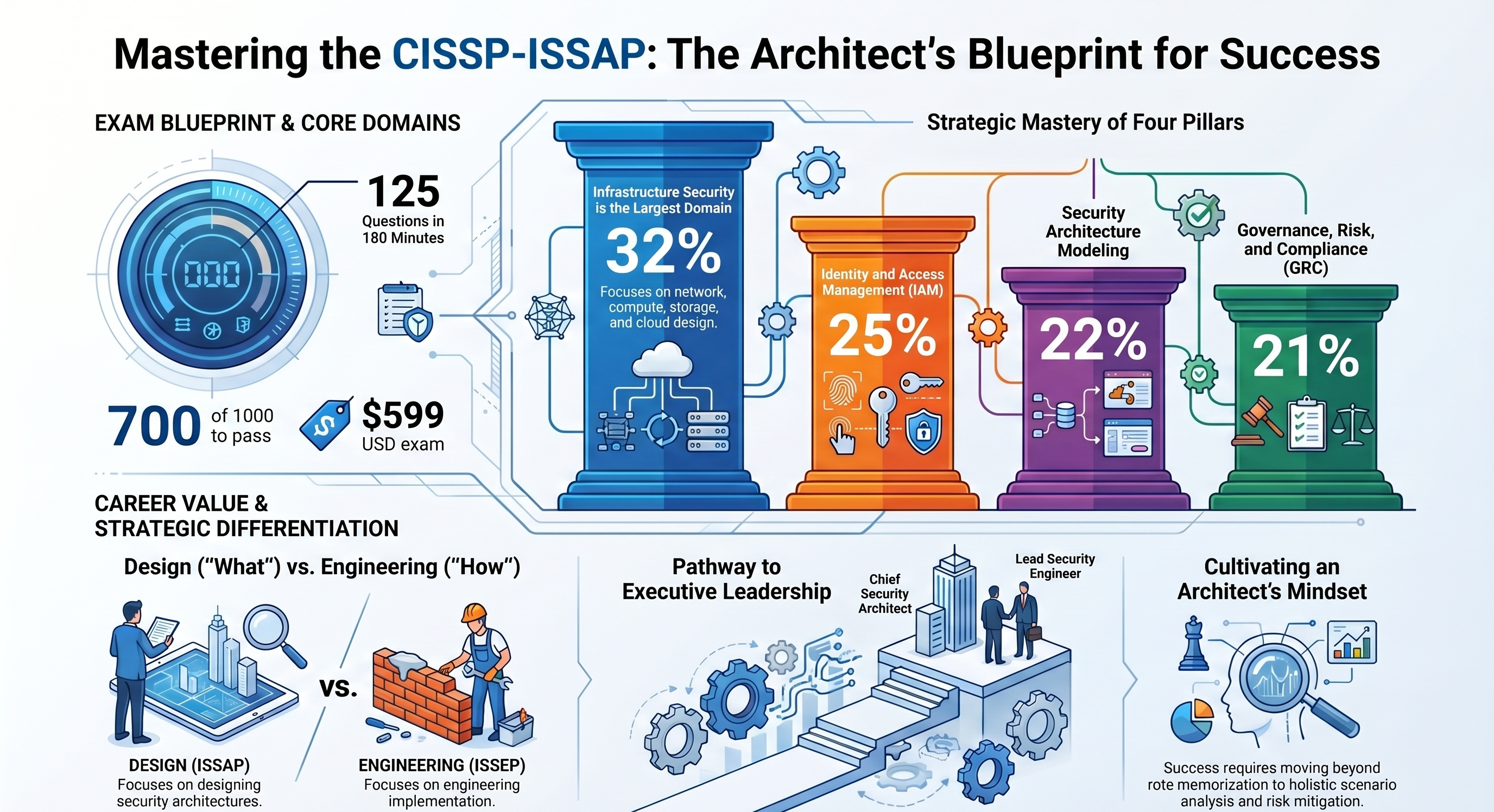
Exam Price: $599 (USD)
Duration: 180 minutes
Number of Questions: 125 multiple-choice questions
Passing Score: 700 out of 1000
This structured format ensures a comprehensive evaluation of a candidate's architectural security knowledge. Success hinges not just on rote memorization, but on the ability to apply architectural principles to real-world scenarios. For more detailed insights into advanced exam tactics, exploring resources on decoding CISSP-ISSAP exam tactics can be highly beneficial for aspiring professionals.
 Core Domains: What the CISSP-ISSAP Exam Covers
The ISC2 CISSP-ISSAP exam blueprint is meticulously designed to assess a candidate's comprehensive knowledge across critical areas of security architecture. Each domain carries a specific weight, indicating the depth of understanding required. Successful candidates demonstrate proficiency in integrating these domains to create cohesive and resilient security designs.
The exam focuses on four key domains:
Governance, Risk, and Compliance (GRC): 21%
Security Architecture Modeling: 22%
Infrastructure and System Security: 32%
Identity and Access Management (IAM) Architecture: 25%
Understanding these weightages helps candidates prioritize their study efforts, ensuring a balanced approach that covers all essential aspects of information systems security architecture. A holistic grasp of these areas is fundamental to designing, developing, and overseeing enterprise security infrastructures.
Top CISSP-ISSAP candidates don't just memorize individual domain facts; they develop a cross-domain vision, recognizing that effective security architecture demands an integrated approach. This "unseen strategy" involves understanding how decisions in one domain, such as Identity and Access Management (IAM) Architecture, directly impact Governance, Risk, and Compliance (GRC) or Infrastructure and System Security. Instead of isolated knowledge, focus on the interdependencies and holistic implications of architectural choices.
Cultivating this cross-domain vision means practicing scenario-based thinking. Consider how a specific architectural design choice - for example, implementing a new cloud security gateway (Infrastructure) - information, trust boundaries, and control points across different architectural layers. For instance, consider how multifactor authentication (IAM) integrates with network segmentation (Infrastructure), how that affects audit logging (GRC), and how it is represented in enterprise architecture blueprints (Security Architecture Modeling). This intellectual exercise helps solidify the connections, making it easier to identify comprehensive solutions rather than fragmented responses during the exam. Understanding these intersections is key to designing secure and resilient systems, a core competency validated by this advanced certification.
A common pitfall for many candidates is approaching exam questions with a purely theoretical mindset. Top CISSP-ISSAP candidates, however, employ a refined strategy of "architecting scenario responses," treating each question as a mini-design challenge rather than a factual recall test. This involves dissecting the scenario, identifying the core business problem or security requirement, and then systematically applying architectural principles to select the most appropriate solution from the given options. It’s about more than just knowing the answer; it’s about understanding the "why" and "how" of the optimal architectural choice within the presented context.
To apply this strategy effectively, begin by breaking down the scenario into its fundamental components.
Identify Stakeholders: Who are the users, business owners, and regulatory bodies involved?
Pinpoint Constraints and Requirements: What are the budget limitations, performance needs, compliance mandates, or existing infrastructure components?
Determine the Core Problem: Is it a vulnerability, a gap in compliance, an inefficient process, or a design flaw?
Evaluate Potential Solutions: For each option, consider its architectural soundness, impact across domains, cost-effectiveness, and alignment with business goals.
This methodical deconstruction allows candidates to move beyond surface-level answers and instead select the option that best addresses the scenario's underlying architectural challenges, much like a real-world security architect would.
Many CISSP-ISSAP scenarios involve trade-offs. The perfect solution rarely exists, and an architect must evaluate the pros and cons of different approaches, balancing security, usability, cost, and operational efficiency. Top candidates excel at this by understanding the implications of each choice. They recognize that a highly secure solution might be too complex or expensive for a given business context, or that a simple solution might introduce unacceptable risks. This critical thinking, which involves weighing various factors and making informed architectural decisions, is a cornerstone of the CISSP-ISSAP exam. It reflects the real-world demands placed on an Information Systems Security Architecture Professional.
The CISSP-ISSAP exam often presents questions that require candidates to not only understand explicit security controls but also to decode the implicit design intent behind a proposed architecture or a given scenario. This third unseen strategy involves looking beyond the surface-level wording to identify the underlying security principles, best practices, and architectural patterns that the question is testing. It’s about recognizing the architectural mindset the question writers expect you to embody.
Consider a question that describes a system using microservices, containers, and API gateways. While it might directly ask about API security, the implicit intent could be testing your understanding of zero-trust architecture, secure development lifecycles, or the principle of least privilege in a distributed environment. Top candidates are adept at identifying these broader architectural patterns and security philosophies that underpin the detailed components. They ask themselves: "What fundamental security principle is this question really trying to assess?" This level of analytical depth moves beyond simple recall and into true architectural comprehension. Accessing the ISSAP ultimate guide can help in understanding these underlying principles more deeply.
Another aspect of decoding implicit intent is anticipating the security implications of various architectural decisions. If a scenario describes the use of a specific technology, consider its common vulnerabilities, default security settings, and how it integrates (or fails to integrate) securely with other components. For example, if a question mentions data stored in a public cloud, the implicit intent might be to assess your knowledge of data residency, encryption at rest and in transit, cloud shared responsibility models, or secure configuration management. This proactive identification of potential risks and necessary mitigating controls based on implicit details is a hallmark of an expert security architect and a crucial strategy for the CISSP-ISSAP exam.
Attaining the ISC2 CISSP-ISSAP certification is more than just adding letters after your name; it’s a strategic career move that solidifies your position as a top-tier security architecture professional. The benefits extend across professional growth, industry recognition, and enhanced earning potential, making it a highly sought-after credential in the cybersecurity landscape.
The CISSP-ISSAP certification significantly elevates your career trajectory. It positions you for leadership roles such as Chief Security Architect, Lead Security Designer, or Senior Security Consultant. These roles typically involve designing enterprise-wide security solutions, leading architectural reviews, and advising on complex security strategies. The certification opens doors to more challenging and impactful projects, allowing you to contribute at a strategic level within organizations. It validates your ability to tackle sophisticated security challenges, translating into greater responsibility and influence.
Holding the CISSP-ISSAP credential from ISC2 signals to employers and peers that you possess an unparalleled level of expertise in security architecture. This enhanced credibility can lead to increased trust from clients and stakeholders, particularly in sensitive projects where architectural integrity is paramount. It demonstrates a commitment to ongoing professional development and adherence to the highest standards in the field. Furthermore, the certification often correlates with higher salary potential, reflecting the demand for professionals who can effectively manage and mitigate architectural security risks in today's complex digital environments.
Preparing for the ISC2 CISSP-ISSAP exam demands a focused and strategic approach. It's not merely about accumulating knowledge but about synthesizing information, applying critical thinking, and practicing scenario-based problem-solving. Effective preparation involves a multi-pronged strategy that addresses both the breadth and depth of the exam domains.
The foundation of successful preparation lies in selecting high-quality study materials. Begin with the official ISC2 study guides and the most current Common Body of Knowledge (CBK) references for the CISSP-ISSAP. Supplement these with reputable third-party textbooks, whitepapers, and industry standards related to each domain. Focus on conceptual understanding rather than rote memorization, especially for complex topics like Security Architecture Modeling and Infrastructure and System Security. Joining study groups or online forums can also provide diverse perspectives and help clarify challenging concepts, fostering a collaborative learning environment.
Practice questions are invaluable for gauging your understanding and familiarizing yourself with the exam's question style. Utilize reputable practice question platforms that offer detailed explanations for both correct and incorrect answers. This feedback is crucial for identifying knowledge gaps and reinforcing learning. It is imperative to engage in ethical study practices, avoiding the use of "exam dumps" which undermine the integrity of the certification and do not prepare you for real-world architectural challenges. Instead, focus on legitimate study resources, which include platforms like mastering ISC2 CISSP-ISSAP questions to reinforce your understanding. This commitment to ethical preparation builds a stronger foundation for your professional career and ensures that your certification genuinely reflects your expertise.
The rigorous nature of CISSP-ISSAP preparation can be demanding, making it essential to manage your well-being throughout the process. Incorporate regular breaks, maintain a healthy lifestyle, and set realistic study goals to avoid burnout. Pacing yourself is key, allowing ample time for review and assimilation of complex architectural concepts. Remember that consistent, focused effort over time is more effective than intense, sporadic cramming. Taking care of your mental and physical health is just as important as your study regimen when embarking on a challenging certification like CISSP-ISSAP.
The ISC2 CISSP-ISSAP certification is a testament to an architect's ability to design, implement, and manage secure information systems. By adopting the unseen strategies of cross-domain vision, precise scenario response architecting, and decoding implicit design intent, candidates can significantly enhance their chances of success. This rigorous exam demands more than just knowledge; it requires a strategic mindset and a holistic understanding of how security principles interoperate across complex enterprise environments. Embrace these advanced preparation techniques to solidify your expertise and confidently approach the exam.
 Conclusion
Ready to validate your expertise in information systems security architecture? Prepare to apply these proven strategies to your study regimen. By committing to a comprehensive and ethical preparation path, you can confidently pursue the CISSP-ISSAP certification, mastering your advanced security certification journey and unlocking new opportunities in your career.
1. Who is the ISC2 CISSP-ISSAP certification designed for?
The ISC2 CISSP-ISSAP is designed for experienced security architects, consultants, and analysts who already hold the foundational CISSP certification and are involved in designing, developing, and overseeing enterprise security architecture.
2. What are the prerequisites for taking the CISSP-ISSAP exam?
Candidates must hold a valid (ISC)² CISSP certification to be eligible for the ISSAP concentration exam. There are no additional work experience prerequisites for the concentration exams beyond what is required for the core CISSP.
3. How long is the CISSP-ISSAP certification valid for, and what are the renewal requirements?
The CISSP-ISSAP certification is valid as long as your underlying CISSP certification remains active. To maintain the ISSAP, you must fulfill the CISSP CPE requirements (120 CPEs every three years) and earn a minimum of 20 CPEs specifically in the ISSAP domains each year.
4. What career opportunities can the CISSP-ISSAP certification open?
The CISSP-ISSAP certification can open doors to advanced leadership roles such as Chief Security Architect, Lead Security Architect, Information Security Architect, or Senior Security Consultant, focusing on designing and implementing complex security solutions.
5. Is it necessary to purchase official (ISC)² study materials for CISSP-ISSAP preparation?
While not strictly mandatory, official (ISC)² study materials are highly recommended as they align directly with the exam objectives and provide comprehensive coverage of the domains. Supplementing with other reputable resources is also a common and effective strategy.